
💡 Traveler’s Pro Tip: If there’s one thing constant travel has taught me, it’s this. Now, I always rely on GetRentacar for getting personal car rental offers directly from local owners. It makes the whole logistics side of traveling far less stressful.
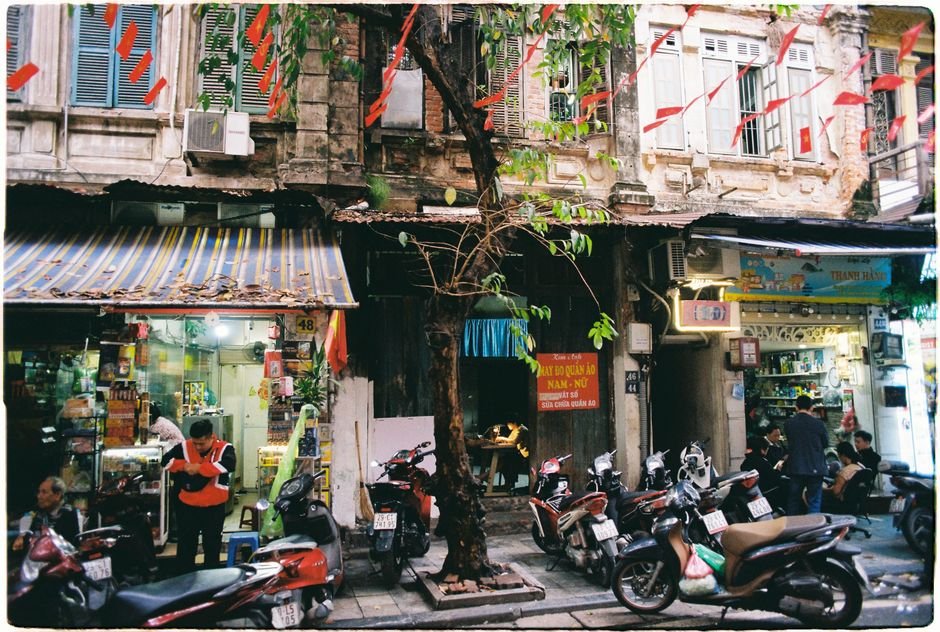
Asian Survival Architecture hits me square in the face the moment I stop on this narrow lane in Hanoi’s Old Quarter, where I’m staring up at a building barely three meters wide but four stories tall, its facade sprouting a tangle of electrical wires, drying laundry, and potted plants crammed onto every available ledge. The locals call these “tube houses,” and the engineering behind them is pure necessity, not vanity.
I got here on Vietnam Airlines, landed at Noi Bai, and immediately learned that the city doesn’t hand you anything easily.
My plan was simple: take the Cat Linh–Ha Dong metro line, the city’s elevated urban rail, straight toward the districts where the older architecture clusters. That plan collapsed within the hour. The line was under maintenance, half the stations shuttered, and I ended up improvising a route through the suburbs on local buses whose numbers I couldn’t read, pressed against commuters hauling baskets of morning herbs. It was confusing. It was also the best thing that happened to me, because it dumped me into neighborhoods tourists skip entirely.
Out there, past the center, I saw the raw logic of how people here build to endure.
Hanoi sits in a flat river delta, soaked by the Red River and hammered by monsoon rains from roughly May through September. The water has to go somewhere, and these tube houses are engineered with that reality baked in. The narrow street frontage comes from old land-tax laws that charged by width, so builders went deep and vertical instead. Inside, I noticed interior courtyards and ventilation shafts punched through the middle of the structure, letting hot air rise out and pulling a cross-draft through rooms that would otherwise suffocate in the humidity. No air conditioning required, just physics the builders understood generations ago.
The materials tell the same story of making do.
Older rural structures around the fringes still use bamboo as load-bearing framing, lashed and jointed rather than nailed, because it flexes under wind and weight where rigid timber would crack. Raised floors and stone footings lift the living space above the flood line. Brick and lime plaster hold up against the wet heat. Nothing here is decorative for its own sake. Every shaft, every raised threshold, every angled roof exists because someone needed to survive the water, the crowding, and the relentless damp. That’s the architecture I came to examine.
Curious for more? There’s a lot more background and detail on Hanoi available on Wikipedia if you want the full picture.

🎧 Listen to my travel diary:
Asian Survival Architecture in the Old Quarter Stilt Logic
I spent the morning crouched on Ma May street, running my palm along the dark hardwood beams of a preserved merchant dwelling at number 87. The timber here is ironwood—lim wood—chosen centuries ago because it resists the rot that creeps up from the saturated ground during the long wet season. Wood swells, but ironwood holds its shape. That is the quiet genius of Asian Survival Architecture in this city: the builders never fought the water, they outlasted it. The ground floor sits a hand’s width above street level on squat timber posts, a deliberate buffer against the standing floodwater that pools in these narrow lanes whenever the drainage overflows. You can smell the difference the moment you step inside—cool, dry air against the wet-pavement reek outside, the faint sourness of aged wood and old incense.
Timber
Every load in these structures travels down through jackfruit and ironwood columns, not walls. The walls are just infill—screens, really. This post-and-beam framework is what let the buildings flex. When the ground shifts or a heavy truck rumbles past on nearby Hang Buom, the whole joint-and-mortise skeleton moves as one piece instead of cracking. There are no nails in the original joints; everything locks with wooden pegs and tenons. I watched a carpenter near the Hoan Kiem Lake district refitting a doorframe using exactly this method, no metal, just a mallet and patience. Insider Tip: the Heritage House at 87 Ma May charges 10,000 VND entry—bring exact change, because the attendant rarely has notes to break a 500,000.
Ventilation
The real survival trick in this climate is heat management, and the old builders solved it with stacked cross-flow. Upper floors sit lower-ceilinged and set back, so hot air rises and escapes through gaps beneath the eaves while cooler air draws in low from the shaded ground floor. I stood under the roofline of a timber house off Hang Bac for twenty minutes just feeling the draft move—steady, constant, no electricity involved. This passive cooling is the backbone of Asian Survival Architecture across the whole Old Quarter, and it still outperforms the rattling air-conditioners bolted onto modern concrete blocks nearby. The wide-angle lens on my DSLR body was the only way to frame the full vertical geometry of these stacked levels; a standard lens clips the top beam every time, and you lose the logic of how the whole thing breathes.
For practical planning, I ran a tight 3-day structural walking route: Day one covered the Ma May and Hang Buom timber cluster, day two the Hoa Lo masonry compound to contrast colonial-era load-bearing walls against local timber framing, and day three the Temple of Literature for its tiled pavilion roofs and column grids. Insider Tip: Hoa Lo entry runs 50,000 VND, and the audio guide add-on is another 100,000—skip it and read the English panels, they cover the same material. I based myself at Hanoi La Siesta Hotel & Spa on Ma May, around 1,450,000 VND per night. The front desk actually walked me to the Heritage House personally when I asked for structural references, and held my heavy camera bag in their locked store room while I shot in the rain. That level of service is rare at this price band.
Endure
Why choose this city over somewhere like Hoi An, which gets all the preservation press? Pure value and density. Hoi An’s old timber houses are beautiful but spread thin and heavily touristed, with entry tickets bundled at roughly 120,000 VND for a multi-site pass. Here, the surviving timber dwellings sit packed block after block, still lived in, still functioning as shops and homes, and most cost a fraction to enter or nothing at all. You get a working laboratory of Asian Survival Architecture instead of a roped-off museum. The engineering responses to crowding are stacked right in front of you: narrow frontages to fit more structures along a single lane, deep floor plans that pull daylight through internal gaps, and flood-tolerant ground levels that accept water damage on cheap infill rather than the structural frame. Insider Tip: come in the dry window from late November through February—humidity drops, the timber stops swelling against the doors, and the caretakers actually open the upper floors you otherwise can’t reach.
What I keep returning to is how unsentimental all of it is. Nobody built these to look old. They built with what the surrounding forests gave them—ironwood, jackfruit, fired clay tile—and engineered against the exact threats this specific patch of ground throws up every year. That pragmatism is why the best examples of Asian Survival Architecture here are still standing while newer concrete boxes already crack. You feel it in the cool draft, hear it in the creak of a pegged joint taking load, and understand it the moment the street outside floods and the floor inside stays dry.
Final Entry: The Weight of Endurance
The last morning in the Old Quarter started with the smell of charcoal smoke and fish sauce drifting through the window of my rented room off Hang Ga. My laptop battery sat at 12 percent, the drone packed away in its case, and I had one final building to understand before I left.
What I kept circling back to was how little waste there is in genuine Asian Survival Architecture. Every material carried weight beyond decoration. The old merchant structures here were built narrow and deep, not for beauty, but because frontage was taxed and crowding was constant. Walls pressed against walls, and the only way air and light moved was vertically, pulled up through gaps engineered to vent the heat that collects in a city this dense. You feel it the moment you step inside: ten degrees cooler, a draft you cannot see but can hear faintly, a low whisper between the floors.
Local builders worked with what the land gave them. Hardwoods that resisted rot through humid, waterlogged seasons. Frames flexible enough to shift without cracking. Nothing fancy, everything practical. That is the honest definition of Asian Survival Architecture here—not a style, but a long argument with the climate that the builders mostly won.
The hidden cost I learned today: entry to several preserved merchant houses runs higher than advertised once you factor the small “photography fee” collected separately at the door, usually 20,000 to 50,000 dong, cash only, no receipt. Budget travelers get caught off guard.
Practical impact: I spent nothing on taxis, ate grilled pork and noodles standing up for 40,000 dong, and saved the cost of an air-conditioned café by simply sitting inside these old structures doing exactly what they were designed to do.
Tomorrow I cross into the Ba Dinh district to study the colonial-era structures around the Presidential Palace grounds—a completely different survival logic worth dissecting before I go.
💻 The Nomad’s Tech Stack
A question I get a lot: how does this blog stay online while I’m bouncing between time zones? The answer is Hostinger. It’s fast, dependable, and never lets me down even when I’m syncing huge photo batches from the middle of nowhere.

More from my travel diary:
Share This Diary Entry
Disclosure: A few links here are affiliate links, meaning I may get a small commission on a purchase, at no additional cost to you.
Important Note: This diary is for entertainment and informational purposes. Always research local laws, travel advisories, and verify transport schedules before embarking on any journey. Affiliate links may be present.